Every so often we might hear about someone offering a ‘random act of kindness,’ usually a small gesture, but a blessing to the recipient. That’s lovely, but in truth, the term is quite misleading. There are no random acts of kindness because everyone we meet and every opportunity that reveals itself was arranged by God; God never does anything that is random. True, we have free will to decide to do the act, but everything has a purpose, and therefore, in all situations, God provides an invitation to which we either respond, ignore, or simply miss because we are not paying attention to His movements in our heart. We always possess freedom, yes, but when we choose to respond positively to God, our empathy and compassion are empowered (and heightened) by the movement of the Holy Spirit to which we have opened our hearts. The opportunity which arises, therefore, is anything but random: God offers it so we might positively affect both our own life and the life of the one we touch through the act. We learn how to identify these movements of His Spirit through prayer and study of Scripture; as we spend time with God, we learn better how He ‘operates,’ and therefore we know how to respond. Thus, the movement of our heart in empathy and compassion is actually His mercy alive and active within us. Our heart becomes one with the Heart of Jesus as we assent to that movement.  It is important to note that the Corporal Works of Mercy are acts of kindness. In His final discourse, as recorded by St. Matthew, Jesus listed them in the culmination of three parables. (Matthew 25)* In the first, Jesus described a wedding feast involving some wise and foolish virgins who were awaiting the arrival of the bridegroom. The wise were those who prepared their souls for the next life, presumably by acts of kindness, compassion, and love. The second parable was about three men given a treasure to keep for a rich man. Two invested, receiving interest, and the third dug a hole and buried his portion, never allowing it to grow. The first two cultivated their gifts, thereby growing (presumably) in holiness; the third did nothing, and therefore remained as he was without furthering his spiritual life. The effect of his inaction was that he squandered an opportunity given by God. In the final parable, Jesus made it clear that feeding the hungry, clothing the naked, welcoming the stranger, and visiting the sick and imprisoned were acts that needed to be central to our response to Him. This means if we want to be His disciples, and more precisely, to be like Him, we must do what He does! This is not only important for the community; it is how we rise in holiness in order to be received into Heaven.  There is nothing in what Jesus said which indicates that He expects perfection from us, but rather that He desires sincere intentions at the heart of our response when opportunities arise. Further, He desires that we begin to seek out opportunities instead of simply waiting for them to present themselves. The truth is that the more we learn to recognize the Holy Spirit and respond to His promptings, the more empathy we will have for those in need; the more acts we do in response to our empathy, the kinder we will become; the kinder we become, the more our hearts are shaped into His own heart. Empathy and kindness can only flow from the mercy of God which is offered to us. When we spend time in prayer, open to the ways we need to heal, grow, let go of attachments, and accept forgiveness (from Him), our hearts expand in love because we will be receiving the mercy of God. And as this process takes place, we grow in empathy and kindness. Remember, all sincere prayer always leads us outward in love. That is, the love that enters into our hearts has to overflow because our hearts are small, and God’s love opens and expands them. Indeed, kindness and empathy grow such that they become one with God’s mercy.  God’s transformative Divine Mercy is the source, the empowerment, and the outflow of our assent to its growth within us. Acts of kindness are not random: God intentionally puts into our path every person who needs us to be His instruments of mercy. Everything is in God’s plan, and therefore, when we see an opportunity, it is because God is working in the life of the other as much as He is working in ours. That is to say, we are intended to be the answer to their prayers! When we commit ourselves to works of mercy in addition to those opportunities that present themselves, God always brings us to the ones who need it at that moment. And as we grow in holiness through our alignment with the Spirit, the possibilities for those to whom we go will increase also. The Psalmist, probably King David, understood the effect and purpose of our growth in holiness as well as how the Holy Spirit works to assist us in this growth. He wrote: “Indeed, goodness and mercy will pursue me all the days of my life and I shall dwell in the house of the Lord forever.” (Ps. 23:6) Because God wants us to spend eternity with Him in His house, His goodness and mercy will pursue us unceasingly. Let us joyfully praise God for that! 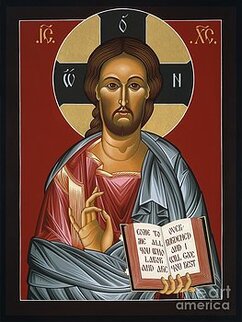 May we learn to discern the goodness and mercy of God which is offered to us! May we respond to His mercy by allowing our hearts to expand in empathy and compassion! And may we become conduits of Divine Mercy as we offer what we receive as a gift to those to whom we are sent! Let us meet in the merciful and loving Heart of Jesus! Peace!
©Michele L. Catanese * In truth the final teaching in Matthew 25 is not a parable, though, some refer to it as if it is. Actually, it lacks the form of a true parable in relation to the 'formula' used in the others told by Jesus that appear in all 4 Gospels. Since that is ‘splitting hairs’ and a bit too technical, I shall refer to the final teaching as a parable. It is the point that I am trying to make that is important. Images: 1. My photo; helping with an injury, blurred. This was taken on the descent portion of a mountain climb near Oropa, Italy. 2. Painting; The Wise and Foolish Virgins, by an anonymous 15th century painter, sometimes referred to as The Alexander Master. 3. My photo; Chapel, Our Lady of Grace, where St. Padre Pio prayed daily. It is also where he received the stigmata, (he was in the choir loft when that happened.) San Giovanni Rotando, Italy. 4. Oil painting; The Good Samaritan by Vincent van Gogh. This is one of my favorite paintings by van Gogh. 5. Icon; Christ All Merciful, by Fr. William Hart McNichols. A copy in one of numerous mediums can be purchased at fineartamerica.com/featured/christ-all-merciful-022-william-hart-mcnichols.html Note: In compliance with GDPR rules, I wish to make it clear that I do not gather any information on any of my readers at any time.
Doris
7/27/2026 07:10:30 pm
Beautiful, so timely and encouraging. More hidden treasures to seek.
Marsha
7/29/2026 03:45:49 pm
I paused several times simply to receive these reflections, the reading felt like an act of kindness in itself! Thank you. Comments are closed.
|

Heart Speaks to Heart
|
 RSS Feed